
Garnett
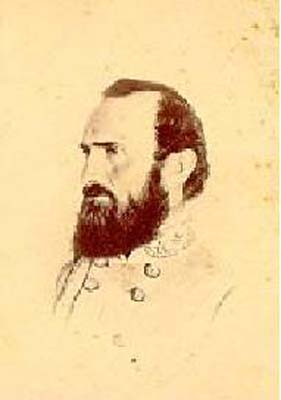
Jackson
LAST MONTH'S PRESENTATION: 4 March 2004
The March meeting of the Civil War Round Table of Greater Kingston featured John Moyer, who spoke about the actions of Lt. Gen. T.J. Jackson and Brig. Richard Garnett subsequent to the First Battle of Kernstown.
JACKSON VS. GARNETT
Given his reputation, the fact that ‘Stonewall' Jackson would arrest and subsequently proffer seven charges of ‘neglect of duty' against an officer he felt had underperformed would probably not surprise most Civil War students. That he would proffer those charges against a general officer with 20 years of military service, a fellow Virginian and the commander of the ‘Stonewall' Brigade might ignite one's curiosity. The CSA general who became the target of Jackson's wrath in the months following 1st Kernstown on 23 March 1862 was Brigadier General Richard Brooke Garnett who, until his death at Gettysburg, bore the stain of Jackson's anger. March's CWRT/GK presentation endeavoured to illuminate the circumstances that caused Jackson to react so vindictively towards Garnett.
Jackson and Garnett were both native Virginians, but from very different backgrounds. Garnett was the older, born on his family's estate in Essex County on 21 Nov 1817. Although a ‘twin', very little is known about his brother. In 1837 he entered West Point with his cousin, Robert Selden Garnett (the first CSA general officer to become a casualty in the war), graduating in 1841. For 20 years he was a professional soldier, serving variously in Florida, New Orleans and on the western frontier. In the spring of 1861 he was in California and at ‘Hancock's Party' with Lewis Armistead, debating whether or not to continue to serve in the Federal army. He concluded his loyalties lay with Virginia and he resigned his Federal commission on 17 May 1861 to enlist in the CSA with the rank of Major. During the summer, he served on the peninsula as the second-in-command of the Georgia Legion. He was promoted Lieutenant Colonel in September 1861 and in October, to Brigadier General. In November, he was appointed to command the ‘Stonewall' Brigade, assuming this post in early December.
Jackson had a more disrupted upbringing. He was born on 21 Jan 1824 in Clarksburg, VA, but following the death of his father and the re-marriage of his mother, spent his formative years with relatives in Jackson's Mill. In 1842 he entered West Point as the alternate congressional appointment, graduating in 1846 17th of a class of 59. George Pickett was 59th. As an Artillery officer, he served with distinction during the Mexican-American War and was breveted three times for courage. The peacetime army wasn't to his liking and in 1851, he resigned his commission to become an instructor of natural and experimental philosophy at the Virginia Military Institute in Lexington. In 1861, Jackson, despite the fact that "he deplored slavery, regretted the rebellion and decried war" chose to fight for Virginia against his country. After a short stint in Staunton, drilling volunteers, he was appointed a Colonel of volunteers by Virginia's Governor and assumed the post of commander of the armoury and arsenal at Harper's Ferry. Having formed a brigade of Shenandoah Valley regiments, he was promoted Brigadier General in July 1861 and commanded them at 1st Manassas, where the brigade was christened the ‘Stonewall Brigade'.
Garnett |
Jackson |
October 1861 finds him in the Valley as a newly promoted Major General and commander of the Valley region, his first independent command. At this point, he has not yet earned the ‘icon' status that awaited him.
Until Garnett arrives in the Valley in December 1861, there is no indication that the two have met. Jackson however, appears to resent Garnett without having met him as he considers Garnett's appointment to command ‘his' brigade an act of political favouritism. From December 1861 to March 1862, there is no serious indication that Garnett had earned Jackson's disfavour. Garnett trained and effectively led the Stonewall Brigade during operations against Dam No.5, towards Hancock and Bath and finally to Romney. Jackson did not favour the brigade either as it was seemingly always in the van, exposed to the dangers of war. Abandoning Romney in January 1862, the Valley Army moved to winter quarters in the Winchester area from January to March 1862.
In early March, some 24,000 Federals, commanded by Major General Nathaniel Banks entered Northern Virginia and threatened Jackson's small army. On 11/12 March, Jackson abandoned Winchester and withdrew up the Valley, eventually halting in the area of Mount Jackson, some 40 miles south of Winchester. The Federals follow but do not press and satisfied that he could contain Jackson with Brigadier General James Shields' Division, Banks begins to move forces out of the Valley. Shields began a move to the north, screened closely by Jackson's cavalry commanded by Lieutenant Colonel Turner Ashby. Jackson has orders from General Joseph Johnston in Richmond to ‘occupy' the Federals in the Valley, preventing them from reinforcing other Federal forces massing on the Peninsula and around Washington.
By the morning of 23 March 1862, the majority of Shields' Division was in and around Winchester, screened to the south by a rearguard. Shields himself had been wounded on 22 Mar near Kernstown during an artillery exchange with Ashby and field command on the Union forces had fallen to Colonel Nathan Kimball, commander of the Union 1st Brigade. As the Confederates advanced to the north, the Federals came south and a meeting engagement developed. Ashby was convinced they were facing only four Union regiments. As Jackson also had received information from ‘spies' in Winchester, he supported this conclusion.
As the main body of his small army approached Kernstown, Jackson saw an opportunity for a victory over what he believed to be an inferior force. Although held up along the Valley Pike, and reluctant to fight on the Sabbath, Jackson issued orders via courier to his brigades that they would turn the Federal right (western) flank by capturing a dominating feature known as Sandy Ridge. Colonel Samuel Fulkerson's brigade would lead the assault, followed by Garnett and the Stonewall Brigade. Despite being Jackson's nominal second-in-command, Garnett was never apprised of Jackson's scheme of manoeuvre and tactical objectives. As the brigades deployed from the line of march and manoeuvred west, they came under intense Federal artillery fire from Pritchard's Knob. Manoeuvring further south and west eased the fire, but they continued to be harassed as they advanced towards Sandy Ridge.
Unknown to the Confederates, other Union formations were also advancing south out of Winchester. Colonel Erastus Tyler's 3rd Brigade was approaching Sandy Ridge from the north and Kimball's own brigade was moving towards Pritchard's Knob. As the Confederates were not yet present on Sandy Ridge, the movement of the Union brigades was masked to them. The first indication that other Federal forces were being deployed occurred when Fulkerson's 27th VA made contact with Tyler's 7th Ohio on Sandy Ridge as both formations raced to seize a stone wall that traversed the height of the ridge. Lt Sandie Pendleton, one of Jackson's aides, was sent forward to count flags and estimated that they were engaging 10,000 Federals. Jackson acknowledged this report by stating: "We are in for it!" There is no evidence to show that Jackson was ever present on Sandy Ridge during the engagement.
Both Garnett and Fulkerson were decisively engaged on the Ridge, and could see Kimball's brigade moving towards them from the east. Tyler already outnumbered them and the Confederates were running short of ammunition as their supply trains had been left to the south. Elements of Colonel Jesse Burks 2nd Brigade had come up on Garnett's right, but it was clear that eventually the Federals would dominate. Under intense pressure from two directions, and running critically short of ammunition, Garnett decided to withdraw the Stonewall Brigade. This uncovered Fulkerson's right flank and he too was forced to retire from Sandy Ridge.
Meanwhile, Jackson had remained in the vicinity of his reserves, placing artillery batteries and eventually leading the two reserve regiments forward intending to support Fulkerson and Garnett. As he advanced, he encountered soldiers withdrawing from Sandy Ridge and attempted to rally them, encouraging them to hold their ground. He met Garnett and although he also tried, Garnett could not stem the movement to the south. The Union formations were on their heals and the reserve regiments that were hard pressed, established a blocking position that permitted the beleaguered brigades to break clean. It was dark by the time they broke away and moved further south screened by Ashby's cavalry providing a screen.
The reversal at Kernstown festered in Jackson and on 1 April 1862, he ordered Garnett's arrest for ‘neglect of duty', relieving him of command of the Stonewall Brigade. Jackson did not stop at one accusation but laid seven separate charges against Garnett. The Valley Army was stunned and in the Stonewall Brigade, reaction was intensely negative, almost to the point of insubordination. The consensus of those who had fought at Kernstown seemed to be that Jackson's action was unreasonable given the circumstances of the battle. From his perspective, Garnett viewed Jackson's prosecution as a personal attack as his "integrity and honour as an officer had been fundamentally questioned". He immediately sought redress through the authorities in Richmond and when this was denied, pressed to have a court martial convened as soon as possible. There was little time for such a proceeding in the coming months due to the tempo of operations. However, as he wanted to again command in the field, Garnett continued to pursue an early resolution. Despite their general empathy towards Garnett, neither General Robert E. Lee, nor the Adjutant General, would defy Jackson. In June 1862, Garnett addressed in detail each of Jackson's charges in a 16-page letter written from Staunton. It is speculated that this emphatic rebuttal caused the Confederate authorities to suspend his arrest on 25 June and grant him a temporary brigade command under Major General D.H. Hill (Jackson's brother-in law).
In preparing his defense, Garnett was also facing the consequences of as continuing operations resulted in casualties amongst probable witnesses. Colonels Fulkerson and Allen, as well as Major Jones, died during the Seven Days, and Turner Ashby fell on 6 June 1861. Garnett's father took to obtaining certified letters from witnesses to Kernstown so that their opinions would be preserved.
On the other hand, Jackson was having difficulty generating support for his position. His only confirmable witness was Lt Sandie Pendleton.
A trial date of 16 July was eventually agreed but it too had to be postponed because of operations. Finally, on 6 August 1862, a Court Martial was convened at Ewell's headquarters at Liberty Mills. The first witness called was Stonewall Jackson; his interrogator, Richard Garnett. Under questioning, Jackson admitted that he had not shared his tactical plan with Garnett and that he had been mistaken as to the size of the Federal force he was facing. He also informed the court that although he foresaw the potential to withdraw from the field, he regretted Garnett's order to move off of Sandy Ridge. When asked how close he had been to the stone wall on the ridge, Jackson answered ‘100 yards', an response that elicited a marginal note ‘lie' by Garnett in the handwritten transcript. Throughout the day, it became apparent that the entire episode was a matrix of ambiguous orders and withheld information.
Day 2 of the proceedings brought Lt Sandie Pendleton to the witness box and he was able to confirm that Jackson had brought all of the army's artillery batteries under his control and in fact, had instructed some of them to retire even before the general withdrawal from Sandy Ridge.
Pendleton never completed his testimony as the court was abruptly adjourned when Jackson received new intelligence about Union movements. He left to organize his forces to meet the Federals at Cedar Mountain on 9 August 1862. The exigencies of war had denied Garnett the acquittal he probably deserved if the court was to believe the evidence that had been presented. He was never to be afforded the opportunity to produce witnesses on his own behalf.
However, on 5 September 1862, Garnett was re-instated and given command of Pickett's Brigade in Longstreet's Division. He effectively commanded at South Mountain, Antietam, Fredericksburg and in southeast Virginia. He died at Gettysburg on 3 July 1863, leading the brigade towards Cemetery Ridge. For his service, he was awarded the Confederate Medal of Honor.
Although wounded in spirit by Jackson's accusations, Garnett chose not to be vindictive. After Jackson's death, Garnett stated to Pendleton; "You know of the unfortunate breach between General Jackson and myself; I can never forget it or cease to regret it. But I wish here to assure you that no one can lament his death more sincerely than I do. I believe he did me a great injustice, but I also believe he acted from the purest motives. He is dead. Who can fill his place?" Garnett was a pallbearer at Jackson's funeral.
In the end, as the court martial did not deliver a verdict, there was no absolute winner. Most commentaries tend to side with Garnett as having been wrongly accuse of ‘neglect of duty' by an inexperienced Jackson who was no where near the heart of the engagement and appears to have made a number uninformed decisions. Regardless of the tactical outcome, the federals reacted by retaining a substantial force in the Valley and kept additional formations around Washington to guard against any raid towards the capital. It has been argued that by retiring his Brigade, Garnett in fact saved the Valley Army that was to engage the Federals in the Valley in the coming months.
-- John Moyer
TOUR OF ANTIETAM
The following advertisement announces an opportunity to visit Civil War sites with Jack Pike of the CWRT/GK:
You can find more information online at Travel History Tours and follow the links to the Civil War May Tour for details of this opportunity.
POEM BY WES ALKENBRACK
The following is the text of a poem by CWRT/GK member and WWII veteran Wesley Alkenbrack. A framed copy of this poem was donated to the Royal Canadian Horse Artillery Club, where the CWRT/GK holds its general meetings.
Gunner's Grave
(from ‘Field Gunners and Other Poems' by Wesley M. Alkenbrack).
We buried Vaux beside the road
A little south of Caen,
An incident upon a day
When we were moving on.
No moment lost for decent praise
To prove his mortal worth:
The blanket and the padre's prayer,
And then the covering earth.
War has such little use for death
We had no pause to dread
That he, who meant so much alive,
Had found no favour dead.
But it was not the meagre cask,
The lonely vast of sky---
The host will gather up its own
Whatever place they lie;
No, only bleakness in the thought,
As each went on alone------
That he would always stay in France,
While we were going home.
A NEW BOOK...
Carman Cumming, a member of the ONC/CWRT, has just had published his book entitled "Devil's Game - The Civil War Intrigues of Charles A. Dunham". An excerpt from the blurb reads as follows: "The first book-length study of one of the Civil War's most outlandish and mysterious characters...a double agent. Dunham was a spy, forger, journalist, and master of dirty tricks...Writing for a variety of papers under alternate names he routinely faked stories...to create new identities...then boldly cast himself to play the roles. His greatest infamy...he was the most notorious of the witnesses to swear that Abraham Lincoln's assassination had been plotted by conspirators in Montreal and Toronto, on orders from Richmond..."
"Devil's Game" is published under ISBN 0-252-02890-2, and is available in cloth at $35.00.
IF YOU CAN HELP...
Peter Blow, a film producer in Peterborough, contacted me recently to ask if anyone in our CWRT knew of any information concerning one William Albert Charles Ryan, a young man from Toronto who served in the 132nd NY Volunteers. If you have any information, or can suggest where Peter might search for information, please contact him by telephone at (705) 743-6021 or by Email at lindum@sprint.ca. This request has been forwarded to the ONC/CWRT.
THIS MONTH IN THE CIVIL WAR:
| April 1861: | |
| Attack on Fort Sumter. When President Lincoln planned to send supplies to Fort Sumter, he alerted the state in advance, in an attempt to avoid hostilities. South Carolina, however, feared a trick. On April 10, 1861, Brig. Gen. Beauregard, in command of the provisional Confederate forces at Charleston, South Carolina, demanded the surrender of the Union garrison of Fort Sumter in Charleston Harbor. The Garrison commander Anderson refused. On April 12, Confederate batteries opened fire on the fort, which was unable to reply effectively. At 2:30 p.m., April 13, Major Anderson surrendered Fort Sumter, evacuating the garrison on the following day. The bombardment of Fort Sumter was the opening engagement of the American Civil War. Although there were no casualties during the bombardment, one Union artillerist was killed and three wounded (one mortally) when a cannon exploded prematurely when firing a salute during the evacuation. From 1863 to 1865, the Confederates at Fort Sumter withstood a 22 month siege by Union forces. During this time, most of the fort was reduced to brick rubble. Fort Sumter became a national monument in 1948. |
|
| April 17 | Virginia seceded from the Union. |
| Four More States Join the Confederacy. The attack on Fort Sumter prompted four more states to join the Confederacy. With Virginia's secession, Richmond was named the Confederate capitol. | |
| April 1862: | |
| April 5 | Yorktown to May 4 |
| April 6-7 | Shiloh / Pittsburg Landing On April 6, Confederate forces attacked Union forces under General Ulysses S. Grant at Shiloh, Tennessee. By the end of the day, the federal troops were almost defeated. Yet, during the night, reinforcements arrived, and by the next morning the Union commanded the field. When Confederate forces retreated, the exhausted federal forces did not follow. Casualties were heavy -- 13,000 out of 63,000 Union soldiers died, and 11,000 of 40,000 Confederate troops were killed |
| April 10-11 | Fort Pulaski, Georgia -- General Quincy A. Gillmore battered Fort Pulaski, the imposing masonry structure near the mouth of the Savannah River, into submission in less than two days, (April 10-11, 1862). , |
| April 16-28 | Fort Jackson / Fort St. Philip-- New Orleans. Flag Officer David Farragut led an assault up the Mississippi River. By April 25, he was in command of New Orleans. |
| The Peninsular Campaign., General McClellan's troops left northern Virginia to begin the Peninsular Campaign. By May 4, they occupied Yorktown, Virginia. At Williamsburg, Confederate forces prevented McClellan from meeting the main part of the Confederate army, and McClellan halted his troops, awaiting reinforcements. | |
| April 19 | South Mills / Camden |
| April 25 | New Orleans - to May 1 |
| April 29 | 1862 Corinth - to June 10 |
| April 1863: | |
| April 7 | Charleston Harbor / Fort Sumter Maj. Gen. David Hunter prepared his land forces on Folly, Cole's, and North Edisto Islands to cooperate with a naval bombardment of Fort Sumter. On April 7, the South Atlantic Squadron under Rear Admiral S.F. Du Pont bombarded Fort Sumter, having little impact on the Confederate defences of Charleston Harbor. Although several of Hunter's units had embarked on transports, the infantry were not landed, and the joint operation was abandoned. The ironclad warships Keokuk, Weehawken, Passaic, Montauk, Patapsco, New Ironsides, Catskill, Nantucket, and Nahant participated in the bombardment. Keokuk, struck more than 90 times by the accurate Confederate fire, sunk the next day. |
| April 11 | Suffolk / Fort Huger / Hill's Point - to May 4 |
| April 10 | Franklin |
| April 12 | Fort Bisland / Bethel Place |
| April 13 | Suffolk / Norfleet House Battery |
| April 14 | Irish Bend / Nerson's Woods / Franklin |
| April 17 | Vermillion Bayou |
| April 26 | Cape Girardeau |
| April 29 | Grand Gulf |
| April 29 | Snyder's Bluff / Snyder's Mill |
| April 30 | Chancellorsville |
| April 1864: | |
| April 3 | Elkin's Ferry Okolona |
| April 8 | Mansfield / Sabine Cross-Roads / Pleasant Grove |
| April 9 | Pleasant Hill |
| April 9 | Prairie D'Ane / Gum Grove / Moscow |
| April 12 | Fort Pillow |
| April 12 | Blair's Landing / Pleasant Hill Landing |
| April 17 | Plymouth |
| April 18 | Poison Spring |
| April 23 | Monett's Ferry / Cane River Crossing |
| April 25 | Marks' Mills |
| April 30 | Jenkins' Ferry |
| April 1865: | |
| April 1 | On March 25, General Lee attacked General Grant's forces near Petersburg, but was defeated -- attacking and losing again on April 1. |
| April 1 | Five Forks. |
| April 2 | Fort Blakely-- Canby's forces, the XVI and XIII corps, moved along the eastern shore of Mobile Bay, forcing the Confederates back into their defences. Union forces then concentrated on Spanish Fort and Fort Blakely. By April 1, Union forces had enveloped Spanish Fort, thereby releasing more troops to focus on Fort Blakely. Brig. Gen. St. John R. Liddell, with about 4,000 men, held out against the much larger Union force until other Confederate forces disengaged and Spanish Fort fell on April 8, allowing Canby to concentrate 16,000 men for the attack on April 9. Sheer numbers breached the Confederate earthworks compelling the Confederates to capitulate. The siege and capture of Fort Blakely was basically the last combined-force battle of the war. African-American forces played a major role in the successful Union assault. |
| April 2 | Selma. Maj. Gen. James H. Wilson, commanding three divisions of Union cavalry, about 13,500 men, led his men south from Gravelly Springs, Alabama, on March 22, 1865. Opposed by Confederate Lt. Gen. Nathan B. Forrest, Wilson skilfully continued his march and eventually defeated him in a running battle at Ebenezer Church, on April 1. Continuing towards Selma, forcing the Confederates to surrender the city, although many of the officers and men, including Forrest and Lt. Gen.Richard Taylor, escaped. Selma demonstrated that even Forrest, whom some had considered invincible, could not stop the unrelenting Union movements deep into the Southern Heartland. |
| April 2 | Hill's Plantation / Cache River / Cotton Plant |
| April 2 | Lee evacuated Richmond, the Confederate capital, and headed west to join with Johnson. |
| April 2 | Petersburg / The Breakthrough |
| April 2 | Sutherland's Station |
| April 3 | Namozine Church |
| April 5 | Amelia Springs |
| April 6 | Sailor's Creek / Hillsman Farm |
| April 6 | Rice's Station |
| April 6 | High Bridge |
| April 7 | Cumberland Church / Farmville |
| April 8 | Appomattox Station |
| April 9 | Surrender at Appomattox Courthouse. General Lee's troops were soon surrounded, and on April 7, Grant called upon Lee to surrender. On April 9, the two commanders met at Appomattox Courthouse, and agreed on the terms of surrender. Lee's men were sent home on parole -- soldiers with their horses, and officers with their side arms. All other equipment was surrendered. |
| April 14 | As President Lincoln was watching a performance of "Our American Cousin" at Ford's Theatre in Washington, D.C., he was shot by John Wilkes Booth. |